|
THE HISTORY
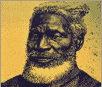
Born in Maryland, Josiah Henson worked as a slave for forty-one years. In 1830, he and his family escaped to Upper Canada (Ontario) via the Underground Railroad. Initially, the Henson family settled near Fort Erie, Ontario, where Josiah gained employment through a local farmer. The family then moved to Colchester, in Essex County, where they settled on previously cleared lots. After a period of seven years, Josiah Henson aspired to obtain his own land. In 1841, he moved his family to Dresden and helped to establish the Dawn Settlement. The settlement was established to provide a refuge and a new beginning for former slaves. Through his leadership, the British American Institute, one of Canada's first industrial schools, was founded. The school was intended for the advancement of fugitive slaves. Josiah Henson's name became synonymous with the central character "Uncle Tom" in Harriet Beecher Stowe's famous novel Uncle Tom's Cabin. The novel sold 300,000 copies within the first year and helped to raise awareness to the brutality of slavery. Abraham Lincoln credited the book as being a catalyst of the Civil War. In 1983, Josiah Henson became the first person of African descent to be featured on a Canadian stamp. In 1999, the Government of Canada erected a plaque designating him as a Canadian of National Historical Significance. The plaque stands in the Henson family cemetery. employment through a local farmer. The family then moved to Colchester, in Essex County, where they settled on previously cleared lots. After a period of seven years, Josiah Henson aspired to obtain his own land. In 1841, he moved his family to Dresden and helped to establish the Dawn Settlement. The settlement was established to provide a refuge and a new beginning for former slaves. Through his leadership, the British American Institute, one of Canada's first industrial schools, was founded. The school was intended for the advancement of fugitive slaves. Josiah Henson's name became synonymous with the central character "Uncle Tom" in Harriet Beecher Stowe's famous novel Uncle Tom's Cabin. The novel sold 300,000 copies within the first year and helped to raise awareness to the brutality of slavery. Abraham Lincoln credited the book as being a catalyst of the Civil War. In 1983, Josiah Henson became the first person of African descent to be featured on a Canadian stamp. In 1999, the Government of Canada erected a plaque designating him as a Canadian of National Historical Significance. The plaque stands in the Henson family cemetery.
|